

Aggressive behavior in dogs should always be taken seriously. This ranges from your dog being aggressive-reactive towards other people or dogs on a leash or protective over his food.
Leash reactivity and aggression remain among the most common dog problems that are presented to qualified dog trainers.
In this article, you’ll learn how to calm down an aggressive dog and how to handle situations in which a dog seems vicious.
Depending on the severity of the aggression and if your dog has a biting history, training might take a couple of months and won’t resolve on its own.
To form an appropriate reaction towards an aggressive dog, you will first have to be able to understand canine body language and the type of aggression your dog might be showing.
Aggressive Dog Body Language
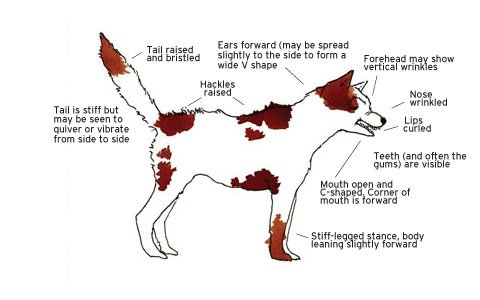
An aggressive dog will show dominant and agonistic signals.
Signals can be more subtle or obvious depending on how much your dog feels threatened.
The behaviors below all build up to an aggressive approach. Your dog might only show a few or all of these signals:
- Increase in body size
- Loud vocalization
- Displacement
- Growling
- Snarling (bared teeth, retracted lips)
- Erect body posture
- Aggressive gape
- Stalking
- Head, neck, and ears are elevated
- Stiff, raised tail
These behaviors display the initial phase of aggression.
When the threat becomes more intense the dog may show a lowered body posture similar to submissive body language to protect the throat during an attack.
The hackles may be raised. Hair raised only on the shoulders and rump indicate fear instead of dominance.
The graphic below shows the typical signs of an agonistic aggressive dog:
Compared to a dog that is showing fear-aggression:
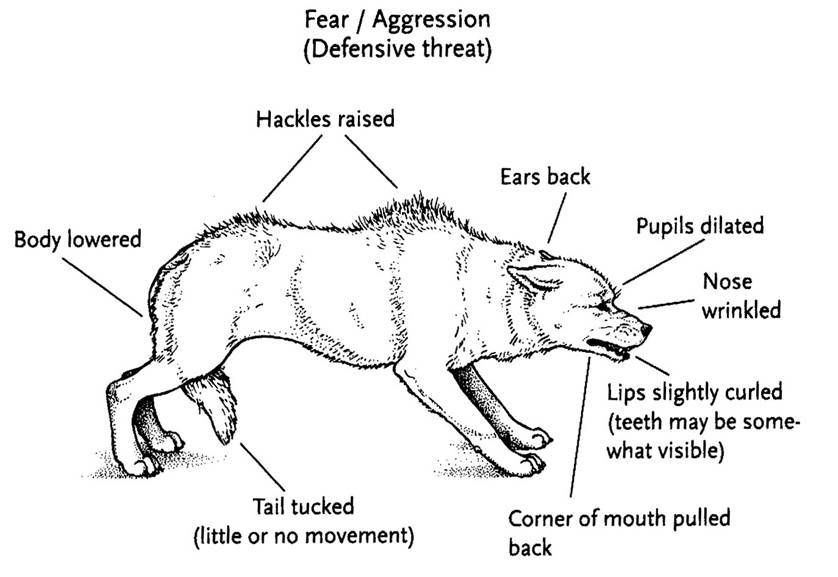
Aggression due to fear and dominant aggression are both equally dangerous. Some dogs will also show a mixture of these two so it’s extremely important to educate yourself about subtle warnings.
Finding the Triggers
Now that you know what aggression looks like, you will need to find the triggers for your dog’s behavior.
Write down every situation in which your dog shows any aggressive signs. Note the surroundings, people involved, sounds, and smells.
This will also give you an insight into the type of aggression your dog is having which will be important to prevent future confrontations with these triggers.
Medical Reasons
Before your dog can be diagnosed with aggression, you should get him properly examined by the vet to exclude any medical issues that might cause aggression.
A dog that is in pain will growl at anyone trying to touch him. While this could include surface wounds, other medical issues or joint diseases will often cause much more pain and aggression.
Dog on Dog Aggression
For some dogs, the mere sight of another canine might trigger inter-dog aggression.
He might be lunging, growling and snapping at other dogs paired with a submissive or dominant body posture.
Dog on dog aggression is a result of a lack of socialization or trauma that might have occurred in his past.
The training goal will be to counter-condition your dog to another behavior that he should be showing toward other dogs.
Instead of lunging or growing, he should lay down or sit quietly. This conditioning will take time and a gradual approach where you avoid sudden confrontations with the trigger.
Fear Induced Aggression
Fear induced aggression can be directed towards humans as well as other animals. A fearful dog shows a tucked tail, ears laid back and a crouched position.
- Fear and anxiety can occur earlier in a dog’s life with early signs by the age of 8 weeks
- Dominance aggression manifests after reaching social maturity (12-18 months old)
Fear is commonly triggered by a stranger approaching a leashed dog or a person suddenly reaching for the dog.
Owners that have been living with this type of aggression usually tighten up and project stress and anxiety onto the dog.
Desensitization and building up your dog’s confidence will eventually resolve the aggression.
If you want to learn more about this type of aggression continue on reading and check out this guide for more information.
Territorial Aggression
A dog that is very territorial will show plenty of agonistic, defensive and offensive signals when strangers or animals approach the property.
Territorial dogs don’t have to be aggressive but rather alert and wary toward strangers.
Uncontrollable aggression will result in injury if a person enters the property or fenced area. You might see the aggressive dog jumping on windows, doors or in a fenced yard trying to scare o
Restrainment with a leash, for example, might lead to displacement or redirected behavior towards objects, animals or people, including the owner.
The longer the person remains within the territory, the more aggressive the dog becomes.
Conditioning your dog to associate the arrival of guests with something positive will eventually stop the aggression. Positive reinforcement training will be your best bet.
Possessive Aggression and Resource Guarding
Dogs can get possessive over objects, food and sometimes even people. Owners are startled when the dog suddenly growls at them when trying to put away a toy or walking by a filled bowl.
This type of aggression emerges from the early survival instinct of guarding resources and often results in food aggression.
Refer to my blog post on how to stop food aggression for the different training steps.
Calming an Aggressive Dog
Calming your aggressive dog starts with noticing the warning signs we have talked about above.
By always paying close attention to your dog’s body posture, you can’t get surprised by sudden aggressive outbursts.
If your dog gets uncomfortable and walks away from you or another person, give him space and don’t make him feel cornered.
Avoid showing threatening behavior to an aggressive dog and follow these instructions:
- Don’t lean over the dog
- Avoid direct eye contact
- Turn your body to the side
- Don’t corner the dog
You also cannot act like prey so running away or slouching into a ball will only make it worse.
If possible, slowly move away from the situation and maybe restrain your dog in a closed room until it’s safe.
The most important thing to remember is to always remain calm.
Startling a lunging dog with a loud scold may result in an attack. A calm demeanor testifies to strength and confidence, traits that will be respected by your dog.
Conquering aggression with aggression never works so you have to establish yourself as the ruling pack leader that communicates calm and nonthreatening behavior without backing down at the same time.
If your dog shows any signs of aggression on a leash, gently remove him from the trigger to build up the distance until your dog has calmed down.
Ignore your dog’s bad behavior and do not pet a dominant aggressive dog. I know you may think it’s comforting, but you’re actually rewarding his behavior.
If your dog is very fearful, massaging his pressure points will release stress and anxiety.
What to Do With an Aggressive Dog That Bites?
Severe cases of aggression with biting history should always be monitored by a dog trainer or veterinary behaviorist.
A trainer will be able to provide you with a training plan and tips on how to correctly handle aggressive behavior.
Treatment for fear-induced aggressive dogs involves minimizing those situations that are most apt to induce fear. Desensitization paired with positive reinforcement work great on fearful dogs.
The trainer will be able to layout any stressors and classify your dog’s aggression into the following categories:
0 = growl/snap/stare, but no contact
- Snap touches skin/clothing but no injury to the victim
- Snap/bite leaving a red mark/bruise/torn clothing
- Single bite with puncture/large bruise/slash
- Multiple bites on the same occasion with punctures/bruising/slashes
- Disfiguring bite that removed a chunk of flesh or multiple severe bites on the same occasion
- Bite resulting in the death of the victim
Biting & Aggression Prevention
Prevention is the best way to stop any aggressive behavior that may result in a bite. If your dog has bitten before, putting a muzzle on him during the training phase will be mandatory.
Prevention starts early with the right socialization. Successfully desensitizing your dog to people, animals, places, sounds,
You can read my guide on early socialization and while the socialization period happens between 3-12 weeks of age, desensitizing an adult dog is definitely possible and advised.
Avoid any known triggers that your dog has like walking by a loud construction site.
Keep
What Not to Do
If your aggressive dog has a dominance issue the following things should be avoided and prevented:
- Never physically punish the dog, rather ignore or redirect the behavior
- Do not give attention if solicited, play will only be engaged by you
- Do not feed your dog from the table
- Do not allow the dog on furniture if he is showing signs of possessiveness
- Play should be calm, leave the room if it gets too rough
- Do not suddenly reach for the dog but recall him instead
- Do not disturb a sleeping dog
- Do not lean over your dog or corner him
- Do not turn your back or run away
It’s also extremely important to not punish growling or other warning signs.
Your dog will only learn that the warning is an issue and the next time he will bite first. Early signs are extremely important for communication and should not be punished.
Depending on the causes, neutering can help with aggression but neutering is never the sole solution to this problem.
Let me know in the comment if you were able to calm down an aggressive dog or what you struggled with.
I know plenty about pressure points in a human, but never even considered them in a dog, except maybe the paws. How silly of me. It’s cool, though, because I used to massage my cat’s neck exactly where this video shows when she was stressed out and she seemed to love it. I love a good neck massage too, so I figured it just felt good. Thanks for your great post! Very informative and worthwhile. Peace!
Thank you for the nice comment, Jeanne! I was also very surprised about the massage points, I am not using them on my dog from time to time just for relaxation.
Great post, I think people can acquire a lot from this web site it’s very useful!
My female spayed 6yr old dog Zodiac attacks my male neutered 5 yr Roswell anytime visitors come over like my kids or grandkids or friends and show him any kind of attention like pet him or talk to him, even if she is getting attention as well. He is very calm natured and she is high strung, loves to play but anxiety prone. In fact she will not go out to the backyard and stay for awhile unless I am out there. Gets antsy when the neighbors are enjoying there backyard or loud noises. When I am out playing in the yard with them she will not let him play. I use an anxiety sweater on her and occasionally give her Benadryl after she has freaked out to help calm her down. What else can I do besides lock her up when we have company? Avoid all socialization with people? Play with them seperately ? I’m desperate for help?
Hello Tracey,
it’s great that you’re seeking advice and I’m glad to give my two cents.
First of all, the anxiety sweater (I’m assuming it’s a Thundershirt?) can be a good start but meds will never take care of the problem’s root. Stronger meds are only for absolute emergencies or cases where they can help with chemical imbalances (which should be proven by a skilled vet beforehand). Locking her up when people come over and especially avoiding socialization will make the problem even worse.
What you should do is work on socialization instead. Invite friends over and make that day about her training. You can start by doing this separately because this way, your female dog Zodiac will associate the visitors with something positive. Once that’s out of the way, you need to work on getting your female dog to accept that Roswell is pet by others and also wants to play.
The best way to solve this jealousy issue is with desensitization and counter-conditioning. You get your dog used to seeing Roswell being pet by other people and treat her when she behaves positively. Start very very small with distance and spacial restriction.
Your female dog is not allowed to intervene with his petting/play because otherwise, it’ll reinforce her negative behavior. Do not pet her if she shows aggressive signs either. Yipping, barking, pulling is not to be encouraged. However, if you’re treating her for good behavior and distract her with her own toys, she most likely won’t notice.
The goal here is to slowly get Zodiac used to seeing Roswell play and accept it. It takes baby steps and time to achieve that but stay persistent.
Desensitizing to sounds works the same way. Expose her to loud sounds and create positive associations with them. Start small and in a calm environment again.
Lastly, it’s important to figure out why and since when your female dog acts that way. Is she a resuce or did this develop recently while she was with you? Is the male dog a new addition to your home or vice versa?
Playing with them separately can work for some time but it won’t take care of the problem’s root and you want both your dogs to live in harmony, right? They don’t need to love each other 24/7 but they need to tolerate each other and locking her up will solve just as little as letting her bully your male dog. I’m sure you can figure this out, it’s really just a matter of using positive reinforcement as long as no serious attack happened.
Check out my socialization article and separation anxiety guide for more.
Cheers,
Danielle
Thank you for this blog, my 2.5yr old Lab Barnaby has started to become aggressive to other dogs. When he wasn’t even a year old he was attacked by two large dogs and before that we socialised him so much. There are plenty of dogs around us to socialise with but I feel like after these two attacks he has become worse. He has attacked a pug and a spaniel. I can’t work out why he does it but I feel like it’s fear aggression. I wanted to know if taking a holistic approach with calming drops would be beneficial to him? He has far more dog friends than bad ones and is such a kind and caring dog but I can’t workout why he wants to attack another sometimes. It’s embarrassing and causing me anxiety as well. Any help would be great!
Hi Emma,
sorry you have to experience this! It’s totally normal to be stressed out when your otherwise lovely dog suddenly displays this kind of behavior.
When you say that he got worse after the dogs attacked him that must’ve been over 1.5 years ago now, right? Have you been socializing him since then or not? After negative experiences, it’s even more crucial to expose your dog to other dogs (and much more). Check out my socialization post for more on that, it’s a never-ending process. My Rottweiler is 2y old now and she still gets to see and play with other dogs every week in order for her to apply the learned behavior.
Taking the approach I lined out above can definitely help but it’s very important to closely watch your dog during interactions. I’d suggest you consult a good dog behaviorist, s(he) should be able to identify the problem pretty quickly. If you want to work on socialization, introduce your dog to the muzzle and use it for safety. Only in calm environments and with carefully selected calm dogs. You want your dog to connect others with positive experiences (especially important if it’s fear aggression).
However, your dog just hit maturity (giant breeds develop until 3 years of age in some cases) and what you perceive as aggression may just be him disliking other dogs. Many owners think a dog has to love every other animal and human on this planet but sometimes they’re just dog tolerant or even selective. This wouldn’t apply if he really hurt another dog as you said (depends if the “attack” was defending from a perceived threat or whatnot).
That’s why a professional can really help to determine the source. Avoid tricky situations but please don’t keep your dog isolated from others or clam up every time you see another dog. I had a pretty overexcited puppy and although it was never dangerous, negative energy and uncertainty will often transfer to your dog.
I’m sure you’ll both make it!
Danielle
I have had my dog for almost a year. I dont think she was quiet 6 weeks when we got her. But in the last few month she has become aggressive with people especially kids. Im trying to fix this problems before I have to get rid of her. I have 2 small children who are loud and hyper and aggravate her when she will allow them too. Im fearful that she is going to attack one of them. I have tried melatonin for dogs, as well as reducing contact with my children and keeping her in a cart wheb there is alot of people over or alot is going on. I can’t keep her outside on her runner alone cause I’m scared she will get off of it and attack someone. What should I do?
Hi Elizabeth,
it’s very important to desensitize and counter-condition your dog to children if you think there’s a problem. Locking her up won’t solve anything and the fact that she came to you too early could have something to do with this (due to bad breeding practices) but the root lies far deeper.
Your children shouldn’t get your dog all riled up but you shouldn’t keep them away either. How to treat the problem depends heavily on your dog’s body language – is she already growling, snapping, isolating, or whatnot? Depending on the degree, a professional behaviorist might be necessary to evaluate the body language and situations.
Don’t give up on your dog, she counts on you to show her how to behave around kids and if you manage to get her to associate children with something positive, the situation you’re seeing now can turn into something quite positive if done right.
Cheers,
Danielle
Hi
My daughter has recently moved back home with her almost 2 year old great dane cross foster care rescue dog.
She had come to her at about 6/7 months with no apparent social training (foster mum had another big male dog/ we noticed it showed dominant behavior with her) and was very anxious around other dogs, strangers and new environments. This anxiousness became pronounced and developed into a more aggressive, dominant prey driven (we think) behavior towards other dogs. (Leashed out walking, also when seeing other dogs through the window in the car (lunging/howling/frothing etc), out walking on a lead, ( if she saw a dog in the distance she would start lunging, whinging/growling/barking/pulling excessively trying to escape to run towards the dog. She has attacked dogs twice when we thought we were alone in an isolated area and these dogs have suddenly appeared off leash. In both incidents, she rushed the dogs, pinned them down by the neck, shaking /biting them.
My daughter has her on anxiety meds, is training her with positive reinforcement, always has a halti on her and sometimes a muzzle (still new to her). It’s very rare if we let her off leash (we risk assess area/ usually take her on night walks, off peak times, enclosed dog parks when there are no dogs around. She shows no aggressive behavior towards us , people she knows well ( she is very “sooky”/affectionate, playful/couch potato at home, responds very well to food based rewards/praise etc…
However, her recall once her anxiety rises, or she has seen another animal etc still isn’t good.
We are really concerned one day our greatest fear will be her actually attacking another dog resulting in killing it … 🙁 This dog is like daughter’s therapy dog for own anxiety..and is considered another family member..
The question is.. can we train her /socialize her? We are hoping with a combination of meds, time, training and desentising her it we can eventually have a semi normal/positive future???
Hey Lisa,
keep in mind that although meds can help, they’re definitely not a long-term solution and training is key to at least get her to a level where she tolerates other dogs. First of all, I’d recommend using the properly fitting muzzle. This is essential if you let her off-leash but even if you don’t, it can really help in situations where others dogs without a proper recall are roaming.
Positive reinforcement is great and most commonly used by dog trainers but it’s very important to distinguish between pure positive reinforcement and other training methods that involve corrections (which never ever include hitting the dog or anything but proper counter-conditioning instead).
The key is to stay calm if your dog is lunging/barking/growling and to make sure that what you do doesn’t reinforce this negative behavior – even though things like petting the dog may seem calming to us, it’s very reinforcing for the dog.
Re-socialising may require lots 1-on-1 situations with other dogs that are very calm and good partners for her (not challenging or “dominant”, but the right kind of energy). It might be best to consult a professional dog behaviorist, especially if there are worries about transferring anxiety to the dog – a dog behaviorist will not only help training the dog but also show you/your daughter how to handle these situations. Negative experiences in the past may have led to this point and if you say “prey-driven”, there might a pattern with her attacking smaller dogs, male dogs resembling the one she lived with, etc. etc. (just a couple of examples). It can be a lot of trouble finding a great one in your area but if you want to commit the time, energy, and money to make sure your dog will be a great canine citizen, this might be the best solution.
A Great Dane mix can be very powerful and large dogs are stigmatised as is already (I should know, I’ve got a totally peaceful Rottweiler), but don’t be deterred by any stupid comments or anything if you’re already in training and working on these issues. If she’s already attacked other dogs and inflicted wounds, it’s even more important to take the right precautions because biting is inherently reinforcing behavior in many cases as it releases hormones in the dog’s brain. A muzzle and spotting any tense body language will prevent such incidents from happening in the future.
Don’t lose hope, it can definitely turn for the better! Time, training, and desensitisation are definitely key factors and as you say, a semi-normal future is definitely possible. Your dog may never be friendly to every other dog but she can learn to tolerate them and canine friends that just fit her character are surely possible too. It just takes the proper training and guidance. It’s a good start that your dog likes people
Cheers,
Danielle
I have a 6 year old shih Tzu dachshund whom nips/bites little kids in the face. My 14 year old granddaughter would constantly blow in the dogs face. Now the biting/snipping is getting worse. How do I reverse this behavior? I am being told to get rid of her. She is my emotional support dog and all I really have.
Hey Kathleen,
first of all, it’s important to know how long your Shih Tzu/Dachshund mix is with you. Did you rescue her quite recently or did you get her as puppy?
If owners have their dog since they’re puppies and this behavior suddenly surfaces, it’s defiitely due to training, changing environments, etc. But if you’ve rescued her, things like this are bound to happen and no problem at all if you’re ready for training.
Is she nipping kids specifically due to them being annoying or would you callm the “love bites“? Dogs can display their love through gentle nipping when they’re too excited, especially with kids. Check the link if you’re unsure whether or not your dog’s body language might be positive.
However, if your dog is annoyed, then it’s within her rights to tell them to stop bothering her. Ideally, a dog should try to avoid the trigger or at least give any other sign like growling (excessive panting, licking lips, etc. can also be signs of your dog being uncomfortable).
As much as a dog needs training, children need to be trained how to treat the dog respectfully, they’re not toys. If I was you, I’d get rid of the person who told you “to get rid of the dog”, especially if it’s – like you said – your emotional support. Dogs are family members and nobody would tell you to get rid of your child, would they?
It’s also important to note the degree to which the biting occurs. Did she break skin or are these nips merely harmless signs of your dog being annoyed? No matter what, this issue can definitely be resolved with the right precautions and training. Let your dog connects kids with positive stuff, not with anything negative. You can do this! While in training, you should consider putting a muzzle on her which avoids further issues for the time being (not a long-term solution though).
Cheers,
Danielle
Hey,
I was wondering if you can give me any advice, I have a 1 yr old golden lab x retriever. He has within the last 6 months or so started to show aggression towards some other dogs and will bark madly at men in the street. This causes me extreme anxiety when taking him out as it is embarrassing. Is there any tips you can give me to prevent this? Thanks in advance
Hi Hayley,
aggression is a word that many dog owners often use to describe their dog’s behavior, however, serious aggression is very rare especially in such a young dog. What you are probably referring to is reactivity (barking, lunging, snarling, snapping) that primarily arises on the leash. 99% of the time reactivity emerges from fear and insecurity rather than aggression.
This could happen due to a lack of confidence, guidance, obedience, or socialization. It’s very important that you stay calm and collected in those types of situations as your own tenseness reflects on your dog.
Think about what might have triggered this behavior. Your dog is still in the midst of his mental and physical development. It takes an event that traumatizes your dog to the point that he is now uncomfortable around other dogs or people. If he is primarily afraid of men desensitize him to as many as possible. Did he meet a lot of men and dogs during his socialization period?
Providing him with as many positive experiences as possible will boost his confidence in the long term.
Try distracting your dog when other dogs pass by giving him a heel or sit command and work on your overall obedience. If that doesn’t work, you will need more distance. Slowly build up to closer and closer encounters over time.
You can also try another method where you take turns with your outer knee crossing your dog whenever he reacts while giving him the heel command (only if you have practiced it before). You can find more information in my guide Training a Reactive Dog.
Cheers,
Danielle
Hi
I have recently rescued a 2 year old pug. All is good until I give him a gentle touch to his collar to redirect him ie get him away from eating content of food bin, get him down off the bed to go to bed and stop him from eating his bed. He has bitten me and my partner. What can I do?
Hey Gemma,
sorry for your current situation but with rescues, you never know their history and he probably never learned the right behavior and is just trying to defend what he thinks should be his. Of course, it’s important not to reinforce this behavior (not immediately backing down either, otherwise he’ll learn that this tactic works). Punishments should always be measured and appropriate though and if redirecting doesn’t help, you can try to act more with your voice. You could try to anticipate situations like this and avoid them.
In general, counter-conditioning will help to get him accustomed to being touched. Reinforce the positive behavior (accepting the touch) with treats, toys, etc. and praise. It may take time but eventually for rescues to get used to new situations and patience is key.
Cheers,
Danielle
We have a 7 month old boxer bitch and 3 year old bulldog who have loved each other since the second they met – the puppy has twice attacked the bulldog this week , it seems like a dominance ‘takeover’ bid for top dog, as she is definitely the more confident of the 2. She is so soft and gentle with humans and a lovely natured dog till this happened
Any advice you can offer? It’s been awful to see – both times it’s been without apparent warning – we removed the boxer puppy , and ignored her for a period and when she reentered the room she’s been quite submissive licking the bulldog and lying next to her but we feel like we waiting for it to happen now ?
A trainer I spoke to today told me I’d have to have her put down!
Thank you
Hey Glenn,
first of all: I do not care who that trainer is but s/he should not be allowed to practice in any job related to dogs, let alone dog training. Unfortunately, many dog trainers are shutting down entirely when “aggression” is at play. Some don’t even accept large and supposedly dangerous breeds in puppy class. The thought of suggesting something remotely similar to putting the dog down is ridiculous.
That being said, no matter how much I love to help and give advice, it sounds like your situation needs in-person training. Most of the time, the hardest thing is really the dog’s body language. You mentioned there was no apparent warning but most of the time, dogs express this in very subtle ways through their body language (lips, eyes, ears, hackles, etc.)
A 7m old puppy attacking a 3y old dog with which she recently played is really uncommon and although first signs of dominance can definitely occur, it’s rare to see this end in a full-on attack. The majority of cases where dogs are labeled as “aggressive” by laymen, they’re not really aggressive. Even among the really aggressive dogs (rare in puppies), the majority of these can be trained and does not need to be put down.
You can turn the situation and steer this pup’s life in the right direction. Note the body language (it shouldn’t happen again, of course, so supervision is necessary) as well as the degree of injury and take her background into account (where did you get her from – reputable breeder with 8 weeks or rescue with history).
Take this information to a dog behaviorist. A real one. Not just CPDT-KA certified or whatnot (good start though), but somebody with a real track record. Dog trainers like Tom Davis (you can check his channel on Youtube) specialize in working with aggression.
Your situation is quite serious and should be resolved asap to avoid any injuries in the future. I have more articles on puppy aggression, dog on dog attacks in the same house and more but that should just be a starting point.
Hope everything will end well for your little family,
Danielle
I bought my little Australian Kelpie just over 3 months ago and every time I walk outside, she jumps up and starts repeatedly biting me. It doesn’t cause me to bleed, but I have multiple scratches and bite marks on my arms and I’m worried that it is not normal. I am wondering whether I should have her go to puppy school or get her checked out. She is currently being trained at home and she knows many basic tricks. She is extremely smart but I cannot get her to stop biting.
Hey Nanami,
if you’ve bought her a little over 3 months ago, is she around 5m old now (assuming you’ve brought her home as a puppy with 8 weeks old)? If so, then she’s still a puppy but the biting part definitely isn’t desirable behavior. It can happen that puppies redirect frustration and bite the leash or whatnot but outright biting you isn’t okay, check out the puppy biting guide for more information on that.
Going to puppy school isn’t necessary in terms of teaching her specific commands/tricks. You can (and should) do that at home. Besides, lots of trainers out there seem to only be able to train tricks or other simple basics. Don’t get me wrong, teaching commands like a proper recall is extremely important as is basic obedience. However, simple tricks are not important and can be trained at the end, not the start.
That being said, what your puppy would learn in puppy school is socialisation which is among the most important aspects. Not only will your dog learn bite inhibition with other dogs, she’ll also have an outlet for her energy and learn social behavior in general with the right guidance.
In regards to the vet: Having her checked out is always a good idea, even though in most cases it’s just a puppy training issue and not a physical or mental issue. Make sure your dog’s healthy before prioritising training.
Cheers,
Danielle
Hello,
We have a one and a half year old Chiweenie (Doxie, Chihuahua mix)
that we got from a rescue at five months old. The past couple of months he has become aggressive toward us for what seem to be odd reasons, such as standing up from the couch and or walking across the room. He will launch himself across the room barking and jumping and nipping without warning. He is also guarding things that are not food. You can take away his food or bone, but he will become quite aggressive if a paper towel or tissue is dropped and someone tries to take it. He also guards things like our shoes and the occasional dead spider that he has killed. We have to lure him into another room and then pick up the item. If we go near it he becomes aggressive. He does not growl or stare, he just goes into attack mode. We love him and do not want to re-home him, but we are overwhelmed and need help. Any advice you can give us would be appreciated.
Hey Jennifer, your struggle with this situation is absolutely understandable. It’s normal for rescues to start with behavior patterns even when they’re 3 weeks or 3 months into being in their new home. However, if you rescued him with 5m and he’s 18m now, that’s probably too big of a delay for behavioral issues.
Since it’s unusual that behavior turns 180 from one day to another (unless medical issues or drastic environmental changes are the cause), this was perhaps quietly happening months before you really perceived it? If there have been environmental changes, what were they? Introducing a new person in the house, moving, another pet, changed the diet, negative experiences outside, etc. etc.
Ask yourself if it could’ve been a quiet change. How was your dog before this all started? Were there absolutely no such issues and you had a clear communication/bond established? If not, you may have dismissed early signs of resource guarding or warning signs. Dogs usually do not just attack, there has to be some clue. It may not be growling but hackles, certain way of sniffing, raised tail, etc.
I’m just asking because a clear way of communication is key before you start any training on resource guarding or whatnot. It’s hard though because you need a balanced approach to solve these kinds of things. Some trainers like to work with positive reinforcement only, others throw the dog into situations that they can’t possibly handle yet which requires a lot of intuition when training. Your dog needs to understand that you’re the chief, not him. Placing him into another room and then picking things up may be a temporary solution but it’s certainly not for the long-term. Personally, I’d remove any items that might cause issues and when issues to arrive, let him know that you do not like that behavior and what you want him to do instead (obedience like a “place” etc. if you’ve already established a set of commands). Avoiding conflict (and prevention in general) and showing your dog how to live with you in harmony is the best way instead of forcing him through situations. If they do arise, you need to stay patient, no harsh punishment but also not giving in.
That’s how I’d personally handle that situation and there are hundreds of different approaches. If you feel like you need help, consulting a certified behavioral consultant (not just any dog trainer teaching tricks) will be your best bet. Requires the commitment to training though (which includes the financials). Your dog probably just hasn’t learned how to properly behave. He’s not trying to get you off the couch, but instead barks, jumps and nips when someone gets up which is quite the odd behavior. It’s not always full-blown aggression that dog owners are dealing with, especially if the dog “just” nips.
Let me know if you have any questions, trying my best to answer them. You can do it and I commend you for trying to work through these issues instead of just re-homing your family member!
Danielle
Hello Danielle,
First of all, thank you for your very helpful website!
My wife and I own an almost 2 years old Corgi who, in the last year, became more and more protective of us against other people coming to our house or approaching us while we are walking him outside. He growls and barks and, in some cases, gives small bites to the ankles (it seems that it’s quite common with corgies). We believe that his aggressiveness might be fear-driven.
Almost one year ago, our vet gave him a temporary chemical castration that was supposed to last 6 months but, for some reason, is still active, so his level of testosterone is still very low. We read that this might the cause of a drop in the dog’s confidence, so we are hoping that, once the chemical castration’s effect will disappear, maybe his behaviour will improve because he will have more self-confidence and therefore he will be less afraid?
We would like to understand what causes this fear of strangers and what we can do to reduce this. We recently got our first baby, so in the near future more and more people will come into our house, so we need a good technique to avoid future issues with aggression to our guests.
Thanks a lot for your help!!!
Hey Mark, I’ve written an article on spaying/neutering in general and the damage it can do, especially if performed too early. Usually, dog owners go for this medical procedure to fix issues, but in nearly all cases, playing around with the hormones is not a universal fix, quite the opposite can happen.
If I may ask, why did you get the procedure done in the first place if not for behavioral issues?
For now, I’m assuming you had absolutely no issue with this behavior before the procedure was done and once he got the temporary chemical castration, he started to develop this behavior (as you said, it’s going on for over a year now)? If that’s the case and the timeline adds up, I’d definitely consider it as part of the cause.
To get rid of this, you’d simply desensitize him to the strangers and counter-condition him.
Where you have to start with desensitization depends on how your dog behaves with strangers in general. Start small and take baby steps. Make sure your dog connects the guests at his house with something positive. Inviting guests shouldn’t be stressful for him because that fear can definitely cause aggression.
However, since biting the ankles is a definitive no-go, I wouldn’t set him up for failure in the near future. Don’t put your Corgi into a situation where you’ll know he will fail just to punish him but don’t encourage this behavior should it occur in a lighter form during training.
I agree with you that the ankle-biting is common with Corgi’s but it’s not because it’s an aggressive breed but rather because the specific breeding line was either poor and/or it’s small dog owners not really putting effort into their dog’s training because it’s a smaller breed. The ankle just happens to be their height.
Provide your dog with the confidence and security he needs and patiently train with people you know, but start slowly and make it positive while discouraging negative behavior. Your dog deserves to feel included and be a part of your family (congrats on the baby)! 🙂
Cheers,
Danielle
Hello Danielle,
Thanks a lot for your very detailed reply!
To answer your question about WHY we decided to go with the temporary chemical castration: we wanted to try and see how and if it would improve his behaviour. Before we did it he was already a little afraid of other people coming to our house, but he never got to be aggressive, he would just move away or, in general, be a bit distressed. This might be caused by the fact that we got him when he was already 4 months old (until then, he spent most of his time with his little brothers and sisters and had very little interaction with people), so we might have missed part of his “socialization window”.
So, in general, he’s never been a very social dog. But we noticed that in the last year his behaviour went from “shy” to “aggressive” towards strangers, and we don’t think it’s just a coincidence that exactly on year ago we did this chemical castration…we are even thinking of going to our vet and ask them to remove that “chemical castration implant”, we don’t even know if it’s possible or if it makes sense, given that its effect is supposed to fade out soon (it was actually supposed to have stopped already, by now…but anyway….!).
Moreover, we believe that this last year of Covid isolation didn’t really help him, since we had almost no visitors so he got used to being home only with us. And we are also afraid that we might have spoiled him a bit too much during this lockdown, allowing him to feel a bit like the king of the house…no one else is allowed to enter!!! We only have a few friends he loves, and when he sees them he is so happy and treats them like us 🙂 So hey, at least he doesn’t hate EVERYONE right? 🙂
My main concern is: could it be possible that, after the chemical castration effect disappears, he becomes even more aggressive?! Do you have any similar experiences?
Anyway, we are now looking for a good dog behaviourist to start proper home sessions, so we can finally address all the issues and have a detailed action plan and stick to it! I really hope it works, we LOVE our corgi!!!
Hey Marcello, first of all, it’s awesome that you’re putting so much thought into how you can help your dog and that you’re reflecting on past decisions.
Unless necessary due to another female living in the house (in which case I’d suggest changing the dynamics to avoid spaying/neutering altogether or finding another solution), I’d never suggest getting a dog castrated, chemically or not.
Asking your vet what you can do now would be your best bet. However, I’m afraid that a vet who chemically castrates a perfectly healthy 1y-old male without second thought won’t be the best to speak to.
Many vets are arguing that neutering avoids testicular cancer, but they ignore all the possible side effects (re: bone cancer in young males and much more) and hormonal changes. Check my neutering guide I linked and read the studies, it’s ridiculous how behind so many vets seemingly are.
That being said, a chemical castration has absolutely ZERO benefits. Of course, he might not mount other females as much. While training can help with the mounting, it’s a trait the dogs are born with and I’d lie if I would say that you can untrain that completely but come on, taking away the hormones doesn’t even necessarily fix that and even if it would, the side effects are still there. Not a good trade-off.
Luckily, a chemical castration isn’t irreversible and once it’s removed and hormone levels get back to normal, you definitely could see an improvement in behavior. While he might get better without proper training, that’s not guaranteed and I’d say it’s essential to provide him with the right training, especially considering that he’s already learned the negative behavior. A lack of socialization can definitely contribute to that issue.
It will take time and patience, but it’s most definitely possible. Get a good behaviorist if that makes you feel more secure, read up on desensitizing/counter-conditioning and see how things are going from there. Not all trainers/behaviorists are golden either but there are incredibly skilled trainers out there.
All the best for you and your Corgi,
Danielle
Hi! I have a 9 month old male Mini Aussie Yorkie mix puppy. We bought him from a local breeder and took him home a little after 8 weeks old. He was so sweet, wouldn’t bark at all, and wasn’t aggressive at all. I’m not sure what changed, but he started showing signs of resource guarding about 2 months after we got him. We’ve taught him “leave it” and he responds well to that, but he’ll still bark and try to snap at you before leaving it. He’s super smart and has learned every command we’ve taught him (sit, stay, leave it, down, off, shake). We recently got him neutered (last week) hoping it would help, but it hasn’t. He now barks anytime someone talks loudly, moves quickly, carries a big object, or gets close to his face (even if he was the one that moved close to them first). He has tried to bite several people he is very familiar with, including myself and my boyfriend who co-owns him with me. It doesn’t just occur in one situation either, we can be in our home, at a park, on a walk, etc. We never use physical punishment but we do usually sternly say no or sometimes yell when he acts aggressively. From your article, I’m thinking maybe we shouldn’t have been correcting him this way? It’s strange because he’s a super friendly dog. He will happily walk up to any stranger and turn on his back to allow them to pet his stomach. He’s really good with kids and other dogs too. We want to take him to a behaviorist, but until then I’m just wondering where to start or at least what not to do. He has bitten me and a few other people before (he’s tiny so it doesn’t do any damage, but obviously still not good), and the barking towards people who appear threatening to him for whatever reason has gotten worse. Is there anything we can do until we can find a professional trainer?
Hey Sierrah, you’re absolutely right with saying that even though he may be tiny, biting is still an absolute no-go. Not only can it hurt you or strangers, think about the psychological damage a bite can do to another dog or a child. Also, nearly every bite-type of aggression is rooted in fear so it’s not a good experience for your dog either.
First of all, you have already gotten the dog from the breeder but personally, I advise against getting crossbreeds from a breeder due to the genetic gamble when it comes to diseases and temperament (these two breeds that are in your dog differ wildly). Also, if your breeder failed these breeder questions, it can be that the puppies have been poorly socialized or bred with inappropriate temperaments.
That being said, have you worked on socialization since day one? The breeder has to do the first part but you’ll need to take it from there and familiarize your dog with people, sounds, animals, textures, and son.
Furthermore, neutering almost never helps. On the contrary, I have an article with scientific resources linked where I explain the damage early neutering can do. It’s sad that your vet immediately agreed to do this, have you explained your intention of fixing the behavior? Dogs need the hormones to grow physically and mentally until at least 1-2 years (2-3y for large breeds).
You definitely should correct your dog but there’s a fine line with a calm and clear correction and yelling that achieves (or makes it even worse). It’s good that you have not used any physical punishment as these don’t address the underlying issue.
Taking him to a dog behaviorist/trainer is the best way to go from here. You have to find the cause of why he’s biting, desensitize him to situations that make him uncomfortable and counter-condition him to avoid fearful responses and instead connect the things that scare him with something positive (where you’ll use lots of toys, treats, praise). Of course, you absolutely want to avoid praising negative behavior like a snap or even bite.
Since you say he’s good with kids and other dogs, maybe what he’s doing to you is not really aggressive biting but puppy biting instead? If you’re a first-time dog owner it may be hard to distinguish because most adult dogs don’t display this, but with pups (even though yours is on the older side), it can happen that bite inhibition hasn’t been trained properly.
Hope you’ll get this solved asap, best to you and your pup!
Danielle
We have had our dog 15 mths he was 14 mths old when we got him. He is wonderful with our Grandchildren and Adult children, and if a friend comes in we sit them down with a dog biscuit and let our dog in, but he barks to start with, gets his biscuit and seems settled then but we have an issue with me walking in to room if my husbands in there and our dog growls, moans runs round to pick up his toy, bone or my husband’s slipper, then if I sit down comes and lays down with item by my feet, but the reaction is quite frightening to start with. I ignore it and keep walking most times. He barks when anyone goes past our house, but doesn’t growl, but you’d think he was going through the window. When I walk him on leash he’s good until we see another dog, barks jumps around, so I keep distance and walk him away but with a struggle. We know he’s good off lead with other dogs, as he meets up and plays with another GSD. I feed him, play with him, walk him, can put my hand in his food now too, but it’s the growling showing his teeth at me etc I can’t understand. He’s the 10th GSD we’ve had all lived to over 12 and lived indoors as a family member, never chastised any of them, wouldn’t dream of doing. But have never come across this behaviour. I sit on the floor and he cuddles up to me automatically. My husband can do anything with him. Mind you he struggles like I do with him on lead if he sees another dog, but he only barks and jumps around. He has never bitten me. He’s good with the Vet too, he’s been Neutured.
Hi Sylvia, so basically your dog is growling when you join the room but settles once you’ve fully entered? Paired with the fact that he barks at people walking by (albeit not growling) maybe he’s just startled. Or does he still do this after fully seeing that it’s you?
The fact that he’s jumping around and barking upon seeing other dogs isn’t that unusual. In fact, my dog was pretty overexcited when she was younger too (minus the barking but plus extreme pulling). With training and patience, it went away – maybe this article about overexcited dogs can help you?
Just because he’s good with one other GSD doesn’t mean he’s reliable with any other dog off-leash and that’s totally okay too. We people also don’t like every human equally :).
Also, I have an article on growling when petted (seems contradictory, right) and how it sometimes isn’t intended as we humans think it is.
This article about neutering might also explain the risks and how it could be related to his behavior now if the change occurred at the same time.
Cheers,
Danielle
My 2 year old ChiWeenie only likes my youngest daughter and myself. We were basically the only people he was around the first year of his life. He is possessive of both of us. If either one of his older brothers gets close to us he gets aggressive. When we pet him and try to pet one of his brothers he gets aggressive. He snarls, lunges, and bares his teeth and snaps to bite. Since we are always sitting between him and his brothers, we often get scratched or bit in the process. One of his brothers, Rattle is a Teacup Chihuahua and is 16 and blind and deaf. He cannot defend himself from Ren. My 4 year old 65 lb mutt, Wyatt has always been Ren’s best friend and protector. If Ren gets in trouble or something scares him, he hides behind Wyatt. Wyatt has always ignored when Ren is aggressive toward him, but the last 2 months he has gotten tired of Ren’s aggression and now snarls, lunges, snaps and growls back. I have several scars on my legs and arms now from being in between these battles. Ren has also been potty trained since a couple of weeks after we rescued him as a puppy. But he pees and poops in the house several times a week. They have a doggie door so this should not happen. I have tried everything to stop these behaviors in Ren and have no idea how to proceed.
Hi Laurie, since your ChiWeenie is displaying serious aggression where skin is pierced and a much larger dog fights back, it’s definitely time to hire a trainer/behaviorist who specializes in aggression to figure this out.
The fact that he starts peeing randomly is another sign of his fear and uncertainty, there may be several issues you’ll have to work on. When people say they’ve tried “everything”, we often just try what immediately comes to mind but clearly, the problem is not solved but every dog can be rehabilitated (except for very few genetically rooted aggression cases). Stick with it and solve it asap cause something might go seriously wrong in the near future, especially with a medium-sized dog against a Chiweenie in the house.
Hi,
I found your article very informative. I am fostering a dog that has been in a pound and 2 homes before coming to me, she is very quick to bite, and goes from sitting beside you to pure vicious, I remain calm and turn sideways. She is fine once you have her lead, but very unpredictable once i drop the lead. Lead is attached to harness, so that i can get her out for walks which she loves.
Is there anymore I can be doing to help her?
Hi Jayne,
kudos to you for fostering a dog, especially with a history. What you can do to solve the aggression issue really depends on the cause. While it may seem that a dog suddenly acts vicious, there’s almost always a trigger as well as foreboding body language. It’s hard to say what you can do to address that issue unless you’d provide more information.
In the meantime, giving her the space she needs, not getting agitated or frustrated and avoiding potentially dangerous situations is the best you can do. Other than that, starting training with a behaviorist/trainer might be your best call.
If you’re interested in more information, I have a membership with a couple of eBooks as well as access to a member-only contact form where I’ll try to dive deeper into your specific issue.
Cheers,
Danielle
I have a 2 year old terrier/dachshund mix rescue dog. We have had her since she was about 3 months old. She has slowly gotten more aggressive as she’s gotten older. Certain words can trigger her and she will lunge and snap. We can be sitting on the couch and if we try to move her she will immediately attack. Once she is in the attack mode even when she stops she will lay in her bed and stare or stalk me around the house just waiting for me to say something and then she will go into attack mode again. She doesn’t get aggressive over food or things but she guards people/rooms. I just started giving her anxiety medication but I know that is a short term option. I do what the vet said and don’t engage, turn away and then walk away. But that is when the stalking begins. I would like to see a behaviorist but they are very costly. Just not sure where to go from here. Any ideas or suggestion would be appreciated.
Hi Jennifer,
it sounds like certain words have been conditioned as triggers that cause her to attack. Can you saying something already elicit that attack response or does it only happen after you’ve moved her from the couch and then the stalking/waiting begins? It’s unusual behavior for sure, as is the fact that it gets worse over time if you’re not doing anything to encourage that aggression (although 3 months is quite young and real aggression issues often form later in life so not that unusual after all).
Personally, I would recommend seeing a behaviorist since this problem sounds more complex. Yeah, they’re costly but a good trainer will figure something and tell you upfront about the cost or how long he or she thinks it might take to solve the issue. A first consultation would be a good step, just research them before to make sure you’re not wasting money.
It might seem like a costly investment but if you’re thinking long-term, the peace you’ll gain is much more important, isn’t it?
Danielle
Hi,
We have a very large Akbash dog (120lb) who we got from a rescue 1 year ago when he was 1 year old. He is very sweet with us and almost all people.
When we adopted him we were told he was not good with the other dogs inside the house with the prior owner (and had fought with two of the other dogs previously) but was good with other dogs outdoors. They felt he would do well in a one-dog household (which we are). He was very well behaved with us the first year we had him, but over the past few months slowly became more leash reactive (still ok in dog parks etc.).
However in the last few weeks he has become highly reactive even to cars driving by. Earlier today we hiked and some young (maybe 5 and 7 year old) boys were hiking near us. We passed them and everything was fine, but as they came up behind us again he whipped his head around and growled/barked ferociously at the older child. We had him off leash but I was thankfully in between them and able to grab him before any issue.
To clarify, he has never bitten another dog or person with us (or shown aggression to a human before this) but the incident seemingly came out of no-where and was very alarming. He has happily interacted with our neighbor’s kids and other children before this.
Hi Ashley,
the most common triggers for dogs are people suddenly approaching or cars coming by so it might just be that this behavior was established over time. The only thing you can do here is to desensitize to these triggers and calmly ignore any negative response, reward a positive one.
Has he been properly desensitized to cars before? When the kids came up it could be that he was just startled. Nevertheless, paired with the fact that he’s getting more reactive in general is definitely alarming.
Since there are a lot of things happening at once (cars, kids, leash-reactivity), I’d suggest you consult a professional behaviorist in your area. Trust me, it’s money well spent on a good trainer especially with such a large dog.
All the best to you and your dog,
Danielle
I have a 4 year old Great Dane. He is sweet and gentle with myself and my mom. My fiancé just moved in and some days he is fine with him and won’t growl when he is around and then other times he will growl and even jump up and go right at him in his face barking close to biting him. I don’t know what to do or why he is doing it since it doesn’t happen all the time it just happens out of nowhere. I’m hoping you can help me
Hi Victoria,
maybe your Great Dane is growling due to one of these reasons. Sometimes, dogs growl for attention or as a sign of play. However, it could also be serious. Try to find the cause and whether or not it’s serious and if it is, I’d suggest you consult a professional behaviorist.
Cheers,
Danielle
I have a 1 1/2 year old pit mix. He attacks anybody that gets too close to me.
Why does he do this and how can I train him to stop
Hey Candy, it’s really hard to say why your Pit does this. More information about your dog, the environment this happens in, the severity, etc. is necessary to make suggestions on what training you should start with your dog. I’d suggest consulting a professional if you’re unsure.
I have a 5yr Gsd who was recently pepper sprayed by a neighbor because she escaped. Until then she was always great with other dogs and people, but know will lunge snap and growl. We know it is fear agression but we don’t know what to do. A week later she was in the garage when a someone broke into our house. She opened her kennel door somehow, and the garage door? Still don’t know how. The man beat her and hurt her. No one can get in our hose except the family, and will be attacked if they try. Please help, it shows all the signs of fear agression, but we are at a standstill on what to do.
Hi Averie, I’m sorry these unfortunate events happened to your dog and it’s seriously messed up that your dog was pepper sprayed by a neighbor assuming she didn’t attack. Have you tried talking to her? Establishing a positive relationship again (unless there wasn’t one to begin with) could be an important training step down the road. In general, it’ll probably take lots of training and desensitization again.
I’d suggest you consult a trainer/behaviorist in your area as these are serious issues and you seem to know the causes with certainty, should be fixable to some degree, but again, consult a professional in your and your dog’s best interest.
My problem is that my 6 mo puppy gets aggressive on walks. She jumps up to grab my clothing and really tries to bite me! How do you calm a dog out in public when walking in a public place. Today I ended up with her puncturing my arm in one spot. It doesn’t happen all the time and Franky I’m a little scared of her. She never gets aggressive in the house.
Hi Lori, it’s not entirely clear whether or not that’s really aggression or just overexcitement. No matter what it is, puncturing your arm is definitely not good. When does it happen? When she sees other dogs, smells something interesting, gets startled by bikers, hears loud noises, etc.?
That and her body language as well as where she’s coming from (i.e. properly socialized pup vs rescue dog with potentially negative experiences) are the key to determining how to get rid of the issue.
If you’re unsure, I’d suggest consulting a dog behaviorist before the issue gets really serious. They’ll also help you learn how to communicate with your dog to make sure you’re not scared but can help her instead.
My sister has adopted my 12 year old dog. On the 3rd day into her coming to live there my sisters 14 year old dog attacked my dog while she was resting in her dog bed. The other dog had been stalking my dog for days. This happen 8 years ago when I had visited. I thought it was a one time thing but now it happened again. The first time it was her neck and this time it was the top of her head. My dog was injured in this attack.I feel my dog is in danger. What is your advice? Is it unsafe to keep these dogs together in the same house?My dog has never had a problem with any other dog just this dog. Also my sisters dog had lived with other female dogs up until recently when they both pasted away. Any advice would help.
Hey Maureen, from what you’re describing it sounds like the first incident happened after your dog was introduced to their household 8 years ago and now it happened around the time the other dogs in the household passed away? If so, these changes could contribute to why the attacks happened.
If the dog was seriously injured, I’d definitely suggest consulting a trainer and keeping them separate up until then if left unsupervised. They’re both old so re-homing will be extremely hard and that includes the transition for them and finding a place at all. You might want to look into bringing her home to you if that’s possible for her remaining years. Other than that, separation and perhaps muzzling until you’ve pinned down the reason for the attacks (toys, food, attention, invasion of personal space, etc.).
Keep in mind that older dogs are often in pain so having them checked by a vet can be helpful.
Cheers,
Danielle
I have 5 year old German Shepard he is very aggressive and dominant I don’t know what to do please help me.
Hey Leo,
it’s hard to tell the exact cause of your German Shepherd’s aggression without knowing more. In what situations does he get aggressive – other dogs, small animals, people, kids, bikers? Or is he aggressive towards you when stuff is involved such as sleeping spots, toys, food? All that and how he express the perceived aggression are crucial to know.
If you’re unsure about your dog’s behavior I definitely recommend consulting a dog trainer. They should be able to help you.
I have a 7 year old rescue and a 1.5 year old rescue. The older one had never had an issue with another dog until meeting my college roommates dog when she was 4. They would fight a lot. After this, she is reactive in dog parks (I do not take her anymore) and on walks (I have to hold her back when another dog is around. But, there are a lot of dogs in my family with whom she has had no issues with. Since I am older now, I was able to afford to send the younger one to a board and train for 2 weeks as soon as she had her shots. My two girls got along until the younger turned about 11 months. We sent the younger one back to training for 6 weeks and she came back awesome. The trainer said that most resource guarding dogs end up back at his training facility in less than 6 months. About 3 months after her second training, the girls got in a huge fight and one of them ended up with 3 staples on her side (both got checked out at the vet and were put on antibiotics). They have been separated by a baby gate in the house since this incident. The younger one will make aggressive stances from her side of the gate sometimes (no growling, just very stiff). I do not know if this is something I should correct or what to do. I feel so stressed and lost. They are both a part of the family, but I want harmony back.
Hi Courtney, so there’s a lot going on, lots of missing info on their interaction, circumstances but maybe my opinion helps, would recommend to consult a professional behaviorist though.
Not sure how they were able to fight a lot back then as you put it, after one fight it should be prevented and the issue should be worked on. However, board and train might be good (or bad, depending on the trainers) but you still need to put the work in with your two dogs. Sending the younger one away and getting her back won’t fix anything. If the trainer determined there’s a resource guarding issue, perhaps it’ll help but your older dog might’ve also picked up bad habits, triggers the younger one, etc. etc.
You can’t correct an aggressive stance without knowing why it happens. Find the cause and work from there.
Also, check out this article on dogs fighting inside the house as well as a younger dog attacking the older dog or vice versa.
All these resources might be able to help but ultimately, get a professional to look at it in person. This is not dog training advice, as I just don’t know the full picture, just for educational purposes and as a starting point for you.
Cheers,
Danielle
My girl Lorelei is a 2 year old German Shepherd. Whenever we are getting ready to leave the house she becomes aggressive. To the point where she has bitten me on more occasions than I care to mention. I have never punished her for this behavior because I understand she’s only behaving as a dog behaves. But it gets discouraging because it’s traumatic for both she and I. Ordinarily Lorelei is a sweet and loving dog. It’s like a switch is flipped and she becomes another dog that I don’t know. As bad as the biting can get it doesn’t exceed how heartbroken and discouraged I feel. I dread the time in the morning when I have to get her into the car to go to work. Once she’s in the car all is well and I give her a treat to emphasize the positive aspect of going through this ritual. I don’t know what to do to stop this behavior, and the fact that she goes to work with me isn’t going to change anytime soon. I love Lorelei dearly, but the thought of having to do this for years leaves me saddened. It was suggested to me that I have her spayed when she turns 3 years old (in order to try to prevent cancer and bone issues), but that’s an eternity away. Besides, that’s no guarantee that her aggressive behavior will cease. I’m going to try the pointers that were given to avoid eye contact, etc. to see if it helps.
Hi Marsha,
what you can do depends on why your dog is reacting aggressive in the first place. Is it overexcitement? Biting is not “behaving like a dog” and it’s completely unacceptable. Of course, it also depends on the severity of the bites. Is your dog properly socialized or experiencing any other behavioral issues?
If you seriously want to get to the bottom of this, I’d suggest consulting a professional dog behaviorist before anything serious happens.
You’re right, spaying will most likely not solve this problem unless there’s a medical indication that this causes her behavior to be off which would need to be determined by your vet. Waiting until bone growth has finished is a sensible choice but I’m not sure why your vet said at exactly 3 years? Surely you can ask your vet. Spaying is a serious choice that comes with advantages as well as a couple of risks so it’s essential to read up about any major procedure.
Hi there,
I just recently moved down to Louisiana from Nashville, TN. Since then my Pit Bull Capone has started extremely aggressive behavior towards my younger brother who is 15 jumped at him over his bone and has been barking and aggressively growling at him when he walks by and also to my younger sister who is 17. He is slightly aggressive toward my ex step mom growled at her one time. Weirdly he is completely fine with my dad, I’m really confused, he has seemed to be very loving and friendly towards my dad. He has never been aggressive toward humans before. It is quite scary so I have him put up in a his large dog cage unfortunately when he’s inside but mostly keeping him outside in the back yard with toys and treats/ food and water until his muzzle comes in tomorrow so he can be more free and can get comfortable and acquainted with the new living area including the people in it safely. I’m just nervous and don’t want to have anything bad happen to anyone or my dog. I read your article and it’s very helpful and will use the skills I believe he needs. Do you have any advice that you think would be preferred directly with this situation?
Hey Mikhaela,
as you correctly assumed, the next critical step is a muzzle to keep your dog and the people around safe. Crating the dog is not a long-term solution and you need to get to the bottom of what causes the behavior. Ask if anything has happened between your siblings and the dog, seeing as he seems to be fine with your dad. If not, the enviromental change is a huge factor too but nothing that warrants aggression.
Sudden changes can be due to pain so I’d have him checked out by a vet too. Other than that, your case sounds serious enough to warrant a consultation with a professional behaviorist to analyze the actual behavior and take training steps from there.
I have a 3 year old Bernese mountain dog. We go him from a breeder when he was a puppy. He never showed any aggression the whole first year. After he turned 1 we noticed just little things like grawling if I took his bone. So I would do positive reinforcement and take the bone and if he didnt gravel he got a treat. I did this any chance I could. I also did it with his food bowl and it seemed to work great so we moved on. Then when he was 2 were dog sitting a friends dog who was a 1 year old male and he attacked him several times. For seemingly no reason other than the friend dog walking by him. We thought this was due to a new male in the house and both boys not being fixed. Then just yesterday he bit my son on the leg. The kids were running and chasing each other in the house and he bit my son as he ran by. Then that same night when we came home we let him off his bed he was grawling at our whole family. We had just walked in and walked over to let him off his bed and he was growing. I feel scared around him all the time now and I am terrified he is going to hurt me or my kids. He is a big boy about 115lbs and can do damage as we have seen when he bite my son. I feel like my only option is to get rid of him. Thanks for any advice
I’m really sorry you’re going through this, it sounds very stressful and scary. It’s good that you’ve been trying positive reinforcement; that’s a great start. What you’re describing sounds like serious resource guarding and possibly fear or anxiety-related aggression, especially with the growling at your family and the bite incident.
Right now, safety is the priority. I strongly recommend reaching out to a professional dog trainer or, even better, a certified veterinary behaviorist who can assess your dog in person and create a tailored plan. Sometimes, these behaviors need expert intervention beyond training at home.
In the meantime, manage his environment to prevent situations that trigger aggression. Avoid allowing kids to run near him or take things from him without guidance. Please don’t feel alone; many families face this and get help. Rehoming might be an option if things don’t improve safely, but professional support can make a huge difference before deciding that.